Between Churches and Sanctuaries
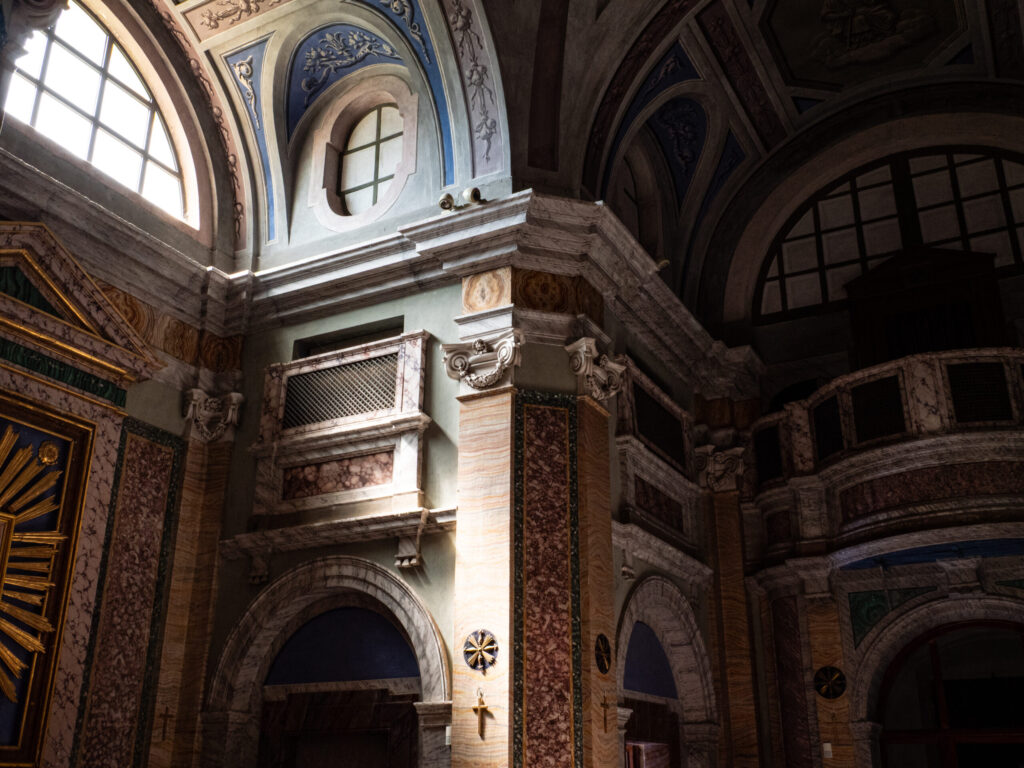
Vetralla preserves an extraordinary spiritual heritage, layered over centuries along the paths of the Via Francigena, the great medieval pilgrimage route that crossed the Tuscia region on its way to Rome. This itinerary leads visitors on an authentic journey through places of worship of rare beauty: frescoed Romanesque churches, cloistered monasteries surrounded by greenery, rock-cut convents clinging to volcanic stone, and sanctuaries born from miraculous events that remain vivid in the collective memory.
This is not just a path for believers: it is a journey through time, history, and the art of a territory that has made faith its deepest language. Every stop tells a story, and every stone bears the mark of centuries-old devotion.
Route Stages
-
1
Church of Santa Maria in Foro Cassi
A first and evocative encounter with the sacred architecture of Tuscia. Located about 1 km northeast of Vetralla, along the route of the Via Francigena, this church represents one of the most significant examples of Lazio Romanesque in the Viterbo area. Rebuilt between the 11th and 12th centuries on pre-existing early Christian structures, it features a three-aisle layout, three semicircular apses, a wooden truss ceiling, and an elegant original rose window on the facade. The interior preserves a cycle of frescoes from the Roman-Lazio school dating between the 12th and 15th centuries, of great iconographic and devotional value. The church stands in an isolated position, in a landscape context that amplifies the sense of contemplation and distance from the world, exactly as it must have appeared to the medieval pilgrims who encountered it on their journey toward Rome.
-
2
Historic center of Vetralla: Church of San Francesco, Cathedral, and Church of Sant'Antonio Abate
The urban heart of Vetralla is home to three places of worship that deserve a close and careful visit, each carrying its own spiritual and artistic identity.
The Church of San Francesco, with an architectural sobriety that follows Franciscan tradition, bears witness to the deep-rooted presence of mendicant orders in the medieval territory of Tuscia.
The Cathedral, dedicated to the city’s patron saint, houses among its most precious works a wooden statue of the Immaculate Virgin, an object of deep-seated popular devotion and a spiritual landmark for the entire Vetralla community.
The Church of Sant’Antonio Abate – also known as the Church of Saints Philip and James – is linked to the cult of Our Lady of Mount Carmel and represents a place of reflection and prayer that is particularly cherished by local devotees.
-
3
Mount Carmel Enclosed Monastery
Adjacent to the Villa Comunale, along Viale D. Tardini at km 67 of the SS Cassia, stands this cloistered Carmelite monastery, wrapped in a silence that invites reflection. The community was moved here from the Rocca di Vico after the bombings of World War II, finding a new permanent home in this location. The monastery houses the remains of two figures of great spiritual and historical significance: Cardinal Domenico Tardini, Vatican Secretary of State under John XXIII, and Don Benedetto Baldi, a priest from Vetralla revered for his life of charity. External visits are possible year-round; for access to the internal church, it is recommended to check the times of the liturgical celebrations.
-
4
Regina Pacis Monastery
In the locality of Giardino, nestled in a landscape of peace and natural beauty, lies the Regina Pacis Monastery, built in 1586. For nearly four centuries, it was home to the Capuchin Fathers, who lived there until 1962. Since 1972, it has hosted a community of Benedictine nuns, who have preserved its original contemplative spirit. The complex is notable for its elegant arcaded cloister, the architectural and spiritual heart of the monastery, which invites visitors to pause and meditate. The site is open to visitors, provided they respect the community’s monastic life.
-
5
Convent of Sant'Angelo on Mount Fogliano
Perched on Mount Fogliano in a panoramic position of extraordinary beauty, the Convent of Sant’Angelo is one of the most historically and spiritually significant sites on the entire route. Its origins date back to the 8th century during the Lombard era, when it was founded as a place of prayer and retreat. Since 1744, it has been home to the Passionist Fathers, and it owes its universal fame to the choice of Saint Paul of the Cross—founder of the Passionist Congregation—to make this convent his residence. The saint lived there for a long time, and his cell is still preserved today and can be visited as a place of pilgrimage. The interior of the convent houses devotional paintings of considerable interest. During the Easter period, the road leading to the convent is transformed into an evocative open-air Via Crucis. Every May 8th, the traditional festival of the “Sposalizio dell’albero” (Wedding of the Tree) is celebrated, an ancient rite of popular devotion that blends the sacred and folklore in a unique atmosphere.
-
6
Hermitage of San Girolamo
About 1 km east of the Convent of Sant’Angelo, hidden among the vegetation and carved directly into the living rock, lies the Hermitage of San Girolamo. This extraordinarily evocative place was the home of Fra Girolamo Gabrielli, a Sienese nobleman who in 1525 abandoned all worldly privileges to retire in penance and prayer in this remote corner of Tuscia. The rock-cut hermitage, in its absolute simplicity, represents the purest form of eremitic spirituality: no ornamentation, no mediation between man and the sacred, only stone, silence, and the light filtering through the Mediterranean scrub. It is a stop that strikes you with its evocative power, still capable today of conveying the profound sense of an inner quest.
-
7
Church of Madonna della Folgore
The final stop on the itinerary is perhaps the most moving, as it stems from a miraculous event still vivid in Vetralla’s collective memory. On August 4, 1955, during a military exercise, about fifty soldiers from the Montebello Lancers Regiment took shelter under a large oak tree during a storm. Lightning struck the tree, but not a single soldier was injured. The event was attributed to the intercession of the Madonna, whose image had been carved into the oak’s tuff stone by Marshal Luigi Buonanno. As a sign of gratitude, this church was built, and it has since become a destination for popular devotion and a place of reflection for those wishing to give thanks for a grace received. A sanctuary young in age, but ancient in the sentiment that inspires it.
Additional Information
This itinerary is suitable for visitors of all ages and does not require any particular physical fitness. We recommend checking the opening hours of each church in advance, as they may vary depending on public holidays and liturgical services.
Periodo Consigliato
Last update: 21 May 2026